
Cancelling a Shared Well Agreement in Arizona?
Is it possible to cancel a shared well agreement in Arizona? The short answer is yes — but the process depends heavily on the specific terms of the agreement and the circumstances surrounding the shared well.
To understand how a shared well agreement may be canceled or terminated, it is first important to understand how these agreements are created and how they function under Arizona law.
What is a Shared Well Agreement?
A shared well agreement is a legal contract between neighboring property owners regarding the use of a shared water well. In Arizona, these agreements are commonly used when multiple properties receive water from the same well and distribution system.
A properly drafted Arizona shared well agreement typically addresses:
- The identities of the parties to the agreement;
- The legal descriptions of the properties being served;
- The location of the well and water distribution system;
- Easements for access and utility lines;
- Water usage rights and restrictions;
- Maintenance and repair obligations; and
- Cost-sharing responsibilities among the parties.
The parties should be identified using their full legal names, and the properties, well location, and easements should be identified using accurate legal descriptions. Most professionally drafted agreements also include diagrams or exhibits showing the location of the well, pipelines, easements, and related infrastructure.
Failure to clearly define maintenance obligations, water usage rights, or cost-sharing responsibilities can lead to significant disputes between neighboring property owners in the future.
In most cases, a shared well agreement should also be notarized and recorded with the applicable County Recorder’s Office so that the agreement becomes part of the public record and binds future property owners.
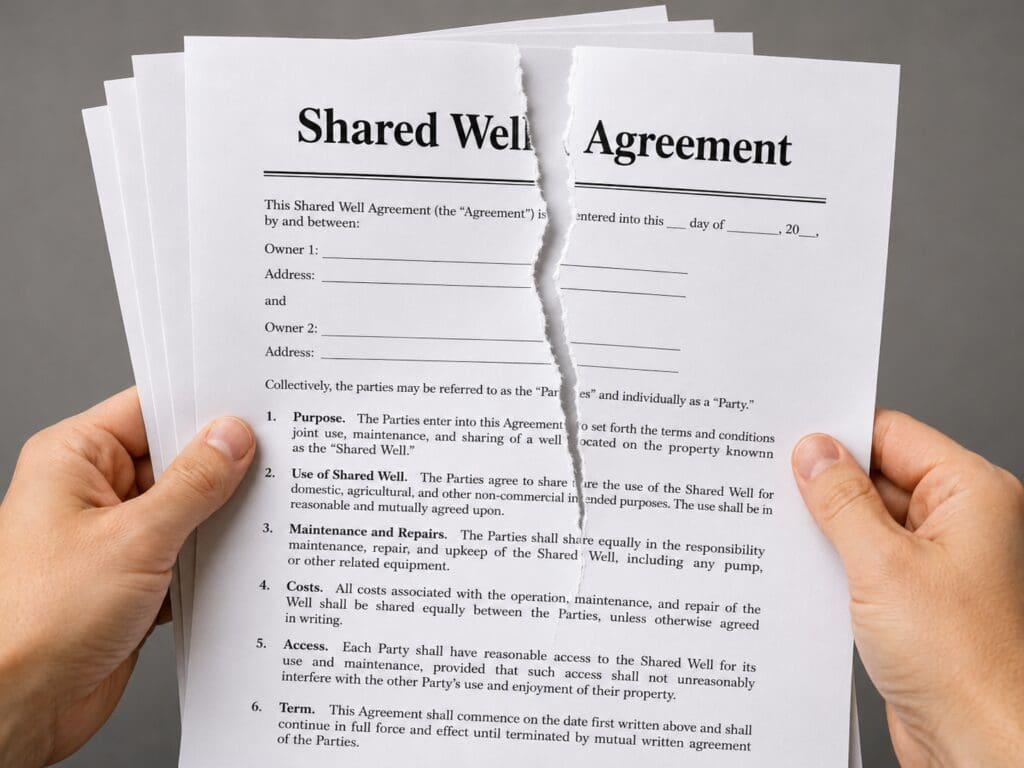
Can a Shared Well Agreement Be Canceled?
Yes. A shared well agreement is a contract, and like other contracts, it may be modified, amended, or terminated if the requirements stated in the agreement are satisfied. Whether a party may withdraw from, cancel, or terminate a shared well agreement therefore depends primarily on the language of the agreement itself. Some agreements allow termination under specific conditions, while others require the consent of all parties or impose continuing obligations that run with the land.
Cancellation Provisions Within the Agreement
Professionally drafted shared well agreements contain specific provisions explaining how a party may surrender or terminate their interest in the shared well system.
For example, the agreement may specify:
- Conditions under which a property may disconnect from the well;
- Whether unanimous consent is required;
- Whether replacement water service must first be obtained; or
- Whether the withdrawing party remains responsible for certain ongoing costs or liabilities.
If the agreement contains a termination or withdrawal procedure, the parties must follow those procedures precisely.
Modification by Unanimous Consent
Many non-professionally drafted shared well agreements fail to address how a party may withdraw from the agreement. In those situations, the ability to terminate or modify the agreement is often governed by the general amendment provisions contained within the contract.
Most shared well agreements contain language similar to:
“This Agreement may only be modified or amended by the unanimous written consent of all Parties.”
When that type of language exists, a property owner generally cannot unilaterally withdraw from the shared well agreement. Instead, termination or modification usually requires the approval and written consent of all parties subject to the agreement.
Legal Issues That May Affect Termination
Even when all parties agree to terminate a shared well agreement, additional legal and practical issues may need to be addressed, including:
- Easement termination;
- Access to existing water infrastructure;
- Replacement water sources;
- Arizona Department of Water Resources (ADWR) requirements;
- Allocation of maintenance or abandonment costs; and
- Recording a formal termination agreement with the County Recorder.
Because shared well systems involve both contract law and real property rights, terminating a shared well agreement should be handled carefully to avoid future disputes or title issues.
Need Help With an Arizona Shared Well Agreement?
At the Dunaway Law Group, we regularly assist Arizona property owners with drafting, reviewing, modifying, and terminating shared well agreements. If you have questions about your rights or obligations under an Arizona well share agreement, our office can help you evaluate your legal options. Call us at 480-702-1608 or message us HERE.
These blog posts are not intended, nor shall they be deemed to render legal advice. Reading these blog post does not create an attorney-client relationship, nor shall it impose an obligation on the part of the law firm to respond to further inquiry. The Dunaway Law Group limits its practice to the great states of of Arizona and New York.